Be Greedy When Others Are Fearful

Wall Street is a crazy place. The minute you think you have it figured, it will inevitably prove you a fool. The famous phrase of bulls, bears and bum steers is parlance for the emotional roller coaster that exists on the street.

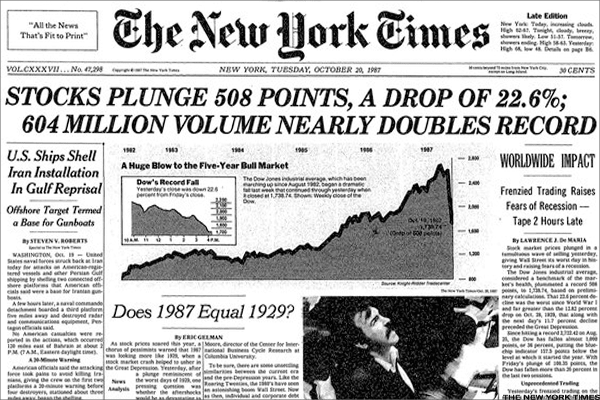
The post image above is a famous stock market crash called Black Monday and it happened October 19, 1987. In fact, it was one of the single worst days on Wall Street. Of course, if you’ve been around long enough you likely will recall many bad periods in the stock market. With all this doom, what is one to do? Say the hell with the market and park your savings in cash? First, let’s take a look at how stocks did in the year 1987 and thereafter. S&P Returns (with dividend reinvestment):

  • 1987 5.1%
  • 1988 16.1%
  • 1989 31.7%

Now to more current events..

December 31st, 2022

What do you suppose the mood was like year end 2022 across the country and in particular on Wall Street? Inflation was high, coming in at 9.1% in June of 2022 on an annualized basis. This caused the Federal Reserve to begin one of the fastest rate tightening cycles in its history. They raised the federal funds rate by more than 500 basis points (5%) between March 2022 and July 2022. For consumers and governments with large debt balances, this was a shock. All of a sudden, in addition to the rapid rise in housing, food and consumer items, servicing debt just got suddenly much more expensive. To say the mood was sour is an understatement to say the least. All of this collectively sent stocks into a tailspin.

Like it or not. Fear and emotions get the best of us when it comes to money. Even the best investors of our time can fall victim to it. Realizing these flaws, how do we counter it? We just keep buying and keeping the right perspective. That’s the answer. Let’s say you bought a farm for 500k. Your intention was to hold it for a long time. What would be your biggest concern? How much it earns each year relative to what you paid is the most logical answer. If prevailing interest rates were 3-5% as they currently are and your investment was producing 50-75k of earnings each year, that’s a perfectly solid investment. You’d need not pay attention to overly optimistic or pessimistic buyers and what they’d offer you for your farm. Hopefully over time with efficiency gains and crop price increases you can grow the earnings and improve the return on equity. The year to year valuations, no matter how positive or negative, need not concern you.

With the sermon out of the way, what did I do differently following the horrible stock market of 2022? Absolutely nothing. Sure I noticed my account balance took a slashing. But I understood why it happened. I know from reading that corporate profits were still excellent. Returns on equity across Wall Street were excellent as well. So I just kept buying. Here is my total stock market purchases for 2022 and beyond:

  • 2022 $36,043
  • 2023 $31,000
  • 2024 $50,000

2022 and 2023 were a bit slower from an investing standpoint due to three roof purchases and a new car, not out of fear. Surely if I had more capital I’d have invested more. So how did this stay the course approach workout you may be wondering?

December 31st, 2024

In case you missed it, these are two front page articles of the Wall Street journal, both the last day of the year, two years apart. My how fast things can change. Admittedly, this was a rather fast turn around in the world of stocks. In fact, we have seen many periods just like this since the 2008 Great Recession. Huge price corrections followed shortly thereafter by record highs. In fact, this has become such a thing, it has its own phrase: BTD (buy the dip).

It’s probably important to note that this isn’t always the case with the stock market. We’ve become immured by a market that seems to do nothing but go up for the better part of 15-16 years. I get the feeling an unshakable confidence is stewing. You see offsets from this confidence boiling over into meme stocks and crypto currencies. After all, it’s been a long bull market with only brief corrections in between. But remember, Wall Street is a humbling place.

Let’s recall two 17 year periods from 1964-1981 and then 1981-1998. These two periods are such a fascinating case study of Wall Street. The mood towards stocks after WW2 and the Great Depression was not good. It didn’t help that profit margins across corporate America were depressed by the early 80’s thanks to the sledgehammer on the economy from the Fed Chairman Paul Volcker raising interest rates rapidly to cool inflation. This interest rate tightening cycle also acted like a noose to stocks. Yet the economy as a whole was absolutely booming. In fact, GDP during this first 17 year period rose 373%. Still, stocks were unfashionable. As a result, bargains were everywhere. Warren Buffett was famously quoted as saying that living in this era was like being “a sex crazed teenager living in a harem.” But people just did not want to own stocks.

In the period 1981-1998, interest rates dropped from a high of 13.65% to 5.09%. And GDP increased a respectable 177%. Yet business sentiment improved significantly even though the economy wasn’t any materially better than the previous 17 year period. Below is the stock market performance for the two periods.

December 31, 1964: 874.12

December 31, 1981: 875

December 31, 1981: 875

December 31, 1998: 9181.43

Bull markets, bear markets. Doesn’t matter. Keep your wits about you, keep disciplined and keep investing. Betting against America has never worked. Even long periods of awfulness eventually produce satisfactory results to the long term, consistent and patient investor.

Are Stocks A Gamble?

It’s easy to see how investing in the stock market could be considered gambling with your money. It’s like going to Vegas right? You take a dollar amount that you’re comfortable losing and hope that you make the right bets to turn it into more. You might even think that Vegas is safer. At least in Vegas you can win or lose based on your own skill depending on the game you play. This idea that stocks are this crazy gamble and too risky keeps people on the sidelines. In reality the stock market has been one of the biggest wealth creators the world has ever seen. In order to capture that wealth generation you need perspective, understanding and the right approach. Once you have these, you can basically build huge amounts of wealth with basically little to no risk at all. Yes I said it.

First let’s be honest, there is certainly gambling going on with stocks. There always has been. It’s kinda like a community pool, everyone is welcome. Options, selling short and credit default swaps are but a few methods investors use to speculate in markets. These professionals try to make money on short term swings in the markets. These methods can be incredibly profitable if they work. But this is incredibly advanced, and probably should be avoided for anyone who isn’t a professional. Hell, even professionals should avoid these types of trades most of the time. I like to think about investing like baseball. Over my investing career, how do I achieve the highest batting average (compound interest rate)? I don’t need to hit home runs and swing for the fences to be effective. I need consistent singles and doubles. And more importantly, I need to never strike out. So, over the course of my career I have a nice solid average. They say there are two rules of investing. 1. Never lose money. 2. Never forget rule number 1.

Unfortunately, everyone has a story of some huge stock win they had, or your friend down the street who is making a fortune day trading yada yada. And this entices people to start swinging for the fences. Most likely, none of them will outperform the market over time. They may do it for a year or so, but over the course of their investing career they likely will not. Statistically, 78% of mutual funds underperform their benchmarks over a 20 year time frame. And those are professionals! Outperforming markets is a very hard. You can try to dance in and out, time the market, buy the dips and so on. But an honest appraisal of your performance in 30 years would likely show you did worse than the market. And that would be a crappy feeling.

But! If you just consistently buy every month you would have gotten very rich over time by simply owning a boring S&P 500 index fund, as this table below shows. A $5,000 dollar investment with no further investment would have grown to $2,208,355 with a 10.5% compound rate since 1965, which is what the S&P 500 delivered. But as the table below shows, you would have had to deal with some extreme volatility. Understanding what you own and having a long term view helps to calm the nerves.

S&P 500 Returns With Dividends Reinvested:

  • 1965 10.0
  • 1974 (26.4)
  • 1994 1.3
  • 1998 28.6
  • 2002 (22.1)
  • 2008 (37.0)
  • 2021 28.7
  • Compounded Average Annual Gain 1965-2021 10.5%

What Is A Stock, Anyway?

Before you can be comfortable with the stock market, you have to know what a stock is. A stock is not just an arbitrary number that bounces up and down on a chart based on a series of random events. In fact, when you own shares in a company, you own a claim claim check on the net assets of the company now and on the future earnings of the company. A great illustration of this is the NBC show “Shark Tank.” In the show, people who need capital pitch their businesses to a group of investors to raise capital. So if their company is valued at $1 million, they may ask the sharks for $200k of capital in exchange for 20% ownership of the business. Similarly, when a company needs capital to grow, they offer shares to the public in an IPO (Initial Public Offering). By selling partial ownership to shareholders, they avoid taking out a loan or selling bonds, which are required to be paid back with interest. Upon the IPO, a one time transfer of shares is exchanged to the public at a stock’s par value. On IPO day, the difference between the par value and what the shares start trading at is the amount of money that will be raised. It’s a one time transaction. Subsequent trading is then between investors.

It is important to note that each company has a different amount of shares outstanding. This is important because just because a share price is higher than another, this does not mean it’s more valuable. The Value of the company is determined by the share price multiplied by the number of shares outstanding. Example: Washing Trust Bancorp Inc. is a publicly traded company. At present it has 17.35m shares outstanding. Share price is 49.91 presently. (17,350,000 shares * 49.91 per share price= market value) So the whole company is worth 870m essentially. Hypothetically, if you owned 1.73 m shares, then you would own 10% of the company. 9.2m of the 92 million they earned last year would be yours. This is to help illustrate what you really own. You own a piece of a business when you own stocks. Whether you own a small piece via stock, or the whole company, your approach to investment should be the same.

Minimizing Your Risk

What are the Four main risks to investing in the stock market?

  • Buying At The Wrong Time
  • Short Term Thinking
  • Buying The Wrong Stock
  • No consistency

How do you basically eliminate all four risks? Dollar Cost Averaging (DCA) into a broad based market index consistently over a long period of time!

Buying At The Wrong Time: Dollar Cost Averaging is buying into the market consistently, whether share prices are up or down. The benefit of DCA is that it lessens the impact of market fluctuations overtime, all but eliminating the risk of timing the market wrong. Imagine you invest $500 into the market EVERY month. In January, the average share cost you buy is $100, so you’ve bought 5 shares. Then, in February, the average share cost jumps to $150. Now that $500 only bought 3.33 shares. However, in March the average share price is only $50. That means for that same $500 you’ve bought 10 shares. By consistently investing, you’re minimizing the impact of swings in the market. You are also forcing discipline. You are buying less when things are expensive and buying more when prices come down. This all but ensures a satisfactory result over time.

Short Term Thinking. The stock market is a long term game, you need to be willing to leave it in for at least 10 years. Here is an illustration to show just how long term you need to be when thinking about the stock market. The 17 long years between 1964 and 1981 stocks went nowhere. That’s a long time. Stocks were simply unfashionable. But over the course of the century they went up 17,000%. It’s important to keep a long term perspective.

  • Dow Jones Industrials
  • Dec 1964: 864
  • Dec 1981: 865
  • Dec 1900: 66
  • Dec 1999: 11,467

Buying The Wrong Stock. The only reason to buy an individual stock is to try to outperform the market. I mean think about it. You always have the default option of owning a broad based market index. It’s not exciting or flashy. You won’t be bragging to your friends about this hot new Total Market Index fund you bought that’s making you rich. But we know from research that outperforming these indexes over time is futile. So why not take that default option? Personally my largest holding in my portfolio is ITOT, which is a Total Market ETF. I don’t worry about buying the wrong stock. I just own all of them. Simple. I keep is simple as they say. Full disclosure I do own a few individual stocks. This is more the business nerd in me more than anything else. I consider myself a part owner of these companies and enjoy reading the quarterly and annual reports. This is more for enjoyment than trying to beat the markets.

No Consistency. I don’t have any special advice here. This is pure grit. Make it a priority. Pay yourself first. We live in a highly consumer driven economy and society. You can’t possibly be happy without the latest and greatest of everything. To that I say, keep it simple. Keep your life simple. Do some stuff yourself. Hang on to your cars and tech devices. Make stuff last. Lower your consumer footprint. Your future self will thank you tremendously. From my personal experience, you will be happier when you stop relying of “things” to make you happier. Just my two cents. On this topic, here is a great quote from the man himself Mr Money Mustache, one of the top personal finance bloggers..