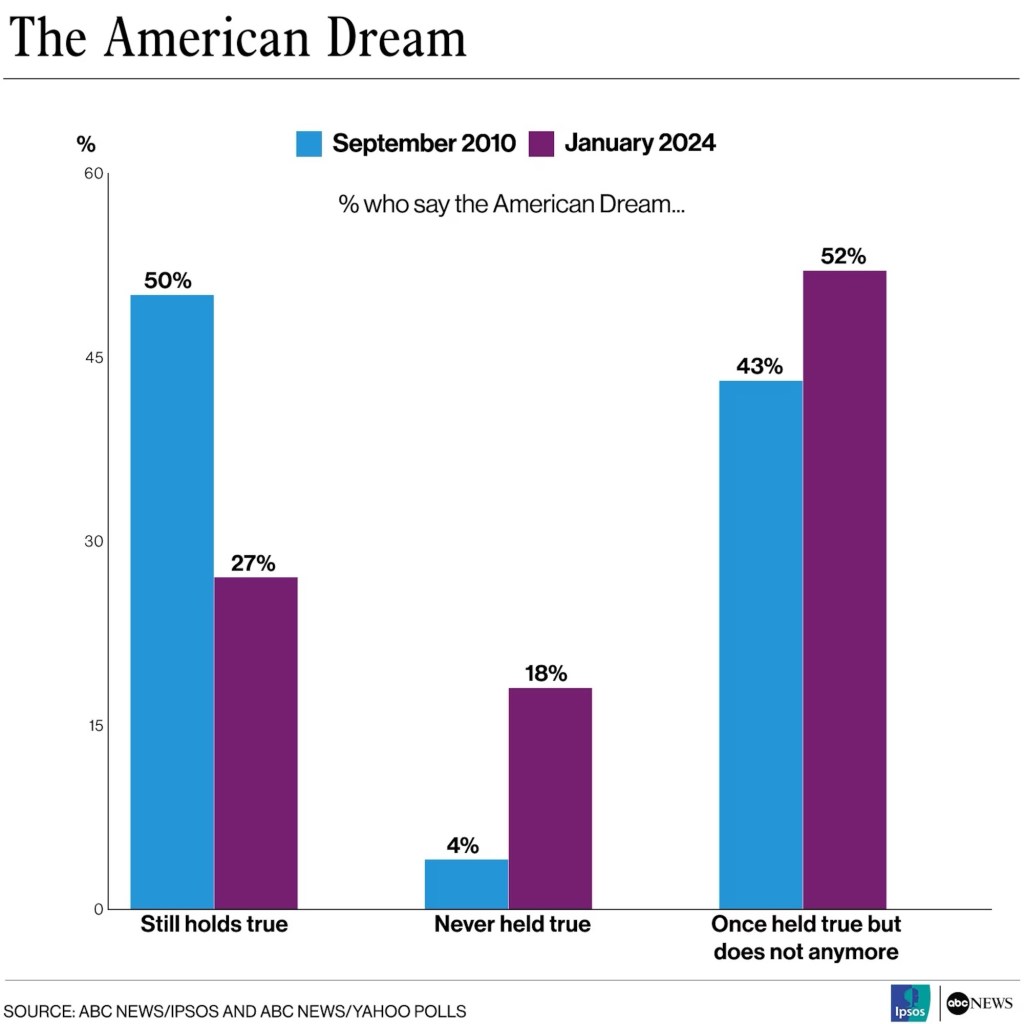
Does the American Dream Still Exist? It’s almost impossible to go a week without hearing someone say that the American Dream is dead. Housing is unaffordable. Cars cost a fortune. Young people feel like they’ll never get ahead.
You’ll even see headlines suggesting that the United States may be experiencing negative net migration—meaning more people could be leaving than entering the country for the first time in a long time.
That raises an interesting question: Are people leaving because the American Dream no longer exists? Or is something else going on?
Because while it’s easy to get swept up in the emotion of feeling like it’s impossible to get ahead, some of the data tells a more complicated story.
What if the American Dream hasn’t disappeared…What if our expectations for a “good life” have simply grown so large that they’re harder to afford? Let’s look at a few examples:
1. The Size of the American Home
In the 1950s, the average new home in the United States was about 983 square feet. Today, the average newly built home is roughly 2,299 square feet.
In other words, the typical home has more than doubled in size over the past 70 years.
At the same time, family sizes have moved in the opposite direction. The U.S. birth rate has fallen from roughly 3.5 children per woman in the late 1950s to about 1.6 today. So households are getting smaller while homes are getting much larger.
The homes themselves have also changed dramatically.
In the 1950’s one bathroom homes were common. Closets were small. Laundry was often in the basement. “Luxury” meant maybe a second bathroom
Today many homes include: Multiple bathrooms (often with spa-like master suites), walk-in closets, dedicated laundry rooms, home offices or “flex space”, media rooms and huge kitchens.
All of this space and comfort comes at a cost. In the 1980s, the median home price was roughly 3.5 times median household income. Today it’s closer to 5.8 times income.
Some of that increase is driven by land constraints, zoning, and interest rates. But part of it is also simple: We are building much bigger and more luxurious homes than previous generations.
2. The Evolution of the American Car
The same pattern shows up in vehicles. For decades, the American car market was dominated by sedans and compact vehicles.
Today, SUVs and trucks dominate the roads. Modern vehicles come packed with features that were once considered luxury upgrades: large touchscreens, advanced safety systems, heated and ventilated seats, panoramic roofs and sophisticated driver assistance technology.
Vehicles have also become significantly heavier. Average vehicle weight in the U.S. reached record levels in recent years.
All of this has pushed the average new car price above $50,000 for the first time ever. Yes, inflation and supply chains play a role. But consumer preferences play a role too.
Americans are choosing larger, more powerful, and more feature-packed vehicles than ever before.
3. The Rise of the Consumer Economy
Another major shift began after World War II. Before the war, the U.S. economy was heavily focused on production and exports. Saving and thrift were cultural norms, shaped by experiences like the Great Depression.
After the war, something changed. The American economy gradually became consumer-driven.
Today, consumer spending makes up roughly 70% of the U.S. economy.
At the same time:
The first modern charge cards appeared in the 1950s and buying things on credit became widely available. As a consequence, advertising exploded through television almost overnight.
Later the internet and social media made comparison constant. For the first time in history, people could easily see how everyone else lived. Keeping up with the Joneses became easier—and more tempting—than ever before. And with credit, it also became easier to spend beyond your means.
When “Enough” Stops Being Enough
This shift toward consumerism has quietly changed our expectations. A “good life” used to mean: A modest home. One family car. Vacations that were simple and a general focus on saving and stability.
Today the baseline expectation often includes: A large home with multiple bathrooms, two expensive vehicles, frequent travel, the newest technology and constant lifestyle upgrades.
None of these things are inherently bad.
But collectively they raise the financial bar for what people believe they need to be comfortable.
And when expectations rise faster than income and assets can support, it can start to feel like the system is broken—even if opportunity still exists.
Is the American Dream Really Gone?
I’d argue the American Dream is still very much alive. Consider that the average America saved 2-3 times more of their income in the 1960’s than what exists today. I would say expectations is more to blame than lost opportunity.
The ability to build wealth, start a business, invest in markets, and improve your financial situation remains remarkably accessible compared to most of human history.
But there’s an important catch.
The same capitalist system that creates opportunity also creates temptation. It constantly encourages you to consume more, upgrade more, and spend more.
In other words: The American system can build your wealth. Or it can quietly drain it. The difference often comes down to whether you recognize the traps built into a consumer economy.
The Real American Dream
The American Dream was never supposed to mean having the biggest house or the newest car. It meant having the freedom to build a stable, comfortable life through discipline, work, and smart choices.
That opportunity still exists.
But in a culture built around consumption, it requires something that used to come more naturally to earlier generations:
Restraint.
Because in today’s economy, the biggest obstacle to the American Dream may not be the system itself.
It may simply be the price of the lifestyle we’ve come to expect.
To Conclude:
The American Dream isn’t dead. But it does come with a catch. The same system that allows people to build wealth also constantly encourages them to spend it. Bigger homes, more expensive cars, and endless lifestyle upgrades can quietly turn opportunity into financial stress. The dream is still there for those who want it—but in today’s consumer economy, reaching it often requires something that’s become surprisingly rare: the ability to say no.

 Build The Gap
Leave a comment