Fun fact. I’ve never had a budget for more than 2 months.
I’m not using a spreadsheet, an app, or even envelopes of cash. Also, I’m not using color-coded categories for every dollar I spend. The finance software I use regularly has a budget function, but I don’t use it enough to make it beneficial.
In the world of personal finance, that’s basically sacrilegious. Budgeting is treated like brushing your teeth — something every responsible adult is supposed to do. So when I tell people I don’t have a budget, I usually get the look. The one that says, “So… how are you not broke?”
But here’s the truth: I don’t budget, and I’ve still managed to save, invest, and steadily build my net worth. Not because I ignore my money — but because I focus on a different system altogether.
Why Budgeting Never Worked For Me
Budgets are all about your expectation for the future, but I find it more helpful to work with numbers that have already happened. You might feel proud of a detailed budget you spent hours crafting, only to have life throw it all into disarray. I look at that as wasted effort.
Budgets always felt like a plan set up to fail. I would sit down at the beginning of the month with good intentions and tell myself things like, “I’m only spending $300 on groceries,” or “No more than $150 on eating out.” And then real life happened. A birthday dinner. A car repair. A random Target run that somehow cost $186. Oops!
Once I blew one category, the whole budget felt broken. It was like going on a diet, eating one cookie, and deciding the entire week was ruined.
Budgets also made me obsess over tiny decisions instead of big ones. I knew exactly how much I spent on coffee, but I wasn’t thinking enough about the things that actually mattered — like how much I was saving, how much I was investing, and whether my overall financial picture was improving.
After only a few months, I realized the problem wasn’t discipline. It was the method.
What I Focus On Instead:
Instead of budgeting, I focus on what I call the gap.
The gap is simple:
Income – Expenses = Gap
That gap is where the magic happens!
It’s where your savings and investments grow, and where you build the freedom for the future. I’m not so worried about whether groceries cost $412 or $387 this month. What really matters is whether the gap between what I earn and what I spend is growing, not shrinking, which is often called lifestyle creep.
A bigger gap means:
- More money going into investments
- More cushion for emergencies
- More options in the future
If you find that your gap is shrinking over time, that’s definitely a bad sign! Over time you want consistency and growth in your gap.
This change from seeing overspent money as a penalty to viewing it as a scorecard affecting my future made my approach feel more useful and tangible. When I only focused on the budget categories, I think my “why” got lost in the details.
I Automate The Important Stuff (Sort Of)
If you want to avoid budgeting, you can’t rely on willpower. You need a system or routine.
My system focuses on automation. To be clear, I don’t automate my savings because the numbers can change. My monthly gap isn’t always the same, making it hard to automate and get it perfect. Remember, the gap is based on past events, showing what’s already happened. So, when February 1st comes, I look at January’s gap to decide what to do with any extra money. Even though I don’t automate in the usual way, my routine is automatic because it happens every month, consistently.
At the end of each month, the gap money gets distributed to:
- Retirement accounts
- Long-term investments
- Emergency savings
- Debt pay-down
I Track Cash Flow, Not Categories
I don’t worry about sticking to my restaurant budget. I keep track of my spending, but if I go over, that’s okay since I can save in other areas. I focus more on the overall gap than on specific categories. This approach allows for more flexibility.
I ask questions like:
- How much did I earn this month?
- How much did I spend?
- How big was my gap?
- Is it getting bigger or smaller (lifestyle creep?)
I track trends, not perfection. It’s more of a birdseye view approach. To me it feels less restrictive. Some months are messy. Some months are great. But over time, I can see whether I’m moving in the right direction. That’s far more useful than beating myself up over a single overspent category. This approach keeps me focused on outcomes instead of rules.
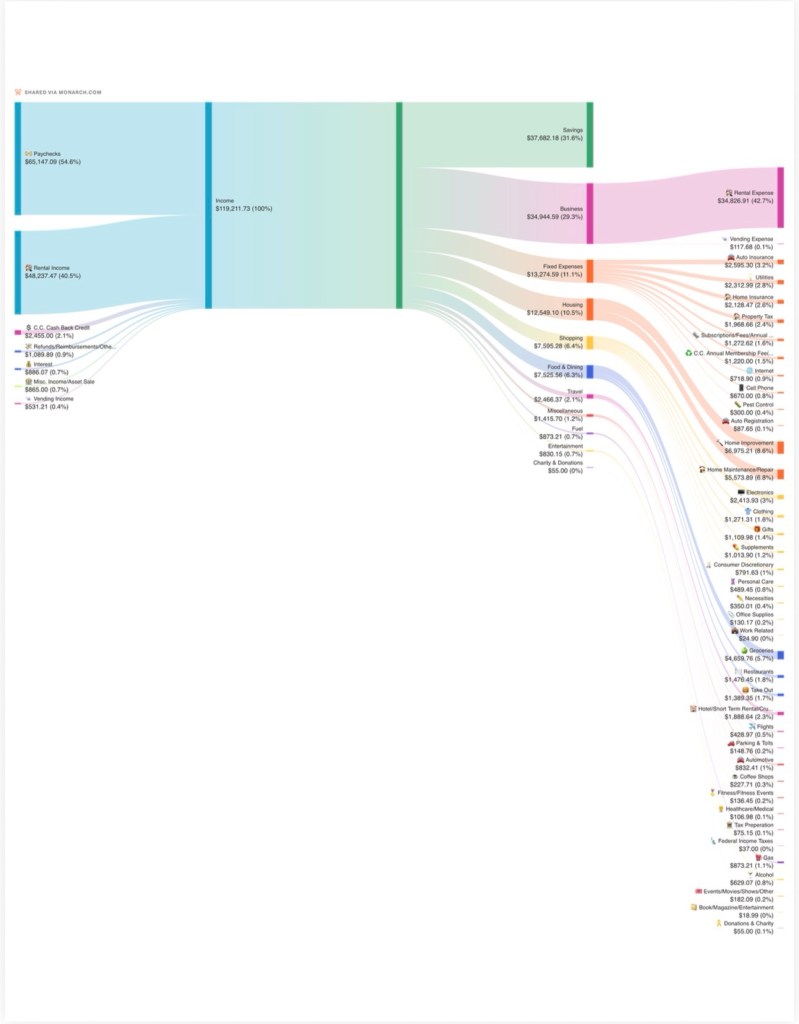
Here is an actual example: the cash flows from left to right. The savings is the gap. As I mentioned earlier, I take that gap and distribute it accordingly.
This Is Not The Same As Having No Plan
A budget is an estimation
Gap is analyzing what has already happened.
Not having a budget doesn’t mean I don’t pay attention to my money. I still know my fixed expenses. I still review my spending. I still make adjustments when things drift too far off course. The difference is that I’m not trying to control every dollar. I’m trying to control the overall direction of my money.
Budgets are about restriction.
Cash flow is about alignment.
I’ve set up my system to give me a broader view, so I can see how my spending fits into my financial plans in the future.
Who This Works For (And Who It Might Not)
This approach works really well for people who:
- Have a stable income
- Are focused on saving and investing
- Hate micromanaging money
- Don’t live paycheck to paycheck
Traditional budgets can be more helpful if:
- You’re digging out of debt
- Money is extremely tight
- You’re brand new to managing finances
There’s no single right way to handle money. The best method is the one you’ll actually stick with. And the one that brings real value to you.
The Real Goal
The goal isn’t to be good at budgeting.
The goal is to build a life where money causes less stress and gives you more options. For me, that meant ditching the budget and building a gap thats consistent and growing.
If budgeting works for you, keep doing it. But if it feels like a diet you can’t maintain, maybe you don’t need more discipline. Maybe you just need a better system.
I don’t want to win at spreadsheets.
I want to win at life.
And for me, that started when I stopped trying to control every dollar and started focusing on the space between what I earn and what I spend.

 Build The Gap
Leave a comment